Dollar expected to reflect Brazil's electoral race, US CPI, and IPCA
- Bullish
- The persistence of doubts regarding the trajectory of US inflation may increase investors' bets on further interest rate hikes by the Fed, putting pressure on Treasury yields and globally strengthening the dollar.
- A benign inflation reading in Brazil may consolidate expectations for the continuation of the basic interest rate (Selic) cut cycle, reducing the interest differential and weakening the Brazil real.
- Bearish
- The strengthening of the perception of a more balanced electoral race, increasing the possibility of government alternation and more conservative fiscal management, may reduce the risk premium of national assets and favor the Brazilian real.
The week in review
- Last week, the electoral scenario was the main driver of the exchange rate of the Brazilian real. Polls of voter intention for the presidency, combined with political news, reinforced the perception of a tighter election, raising prospects for a change in government.
- In the economic indicator agenda, the August Employment Situation Report ("payroll") came in stronger than expected, increasing bets on interest rate hikes in the US in the short term.
USDBRL and Dollar Index (points)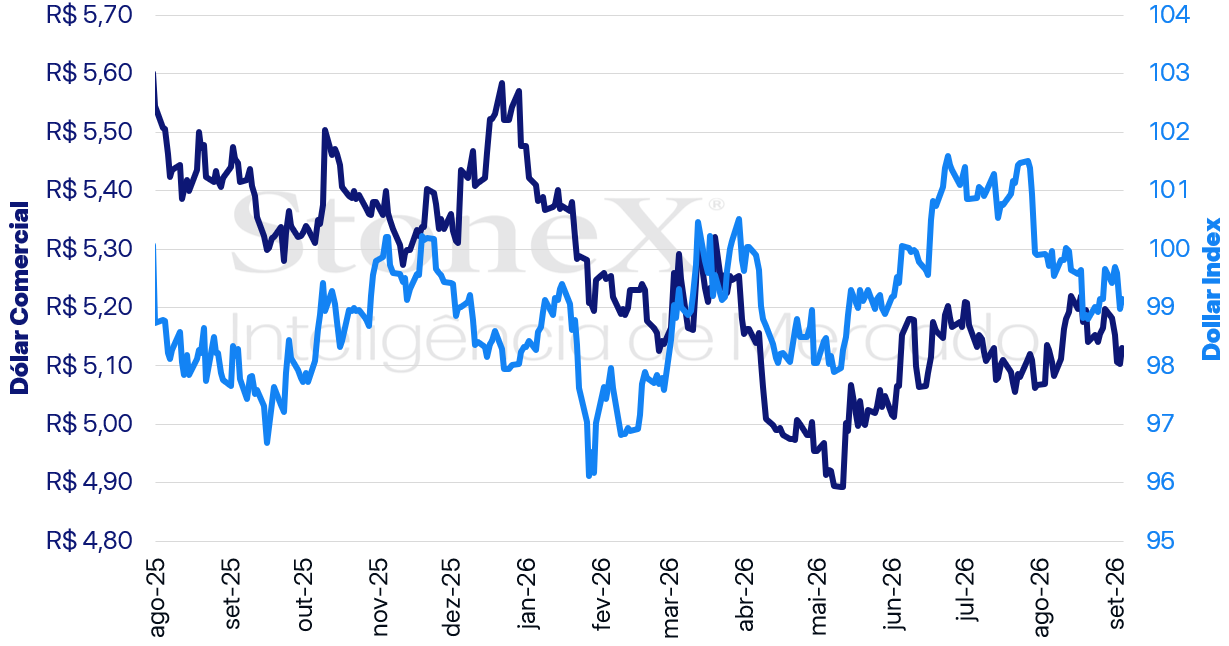
Source: StoneX cmdtyView. Design: StoneX.
USDBRL variations | Daily: +0.53% | Weekly: -1.31% | Monthly: -0.99% | Annual: -6.33% | In 12 months: -5.82%
Dollar Index variations | Daily: +0.16% | Weekly: -0.52% | Monthly: -0.28% | Annual: +0.83% | In 12 months: +0.86%
KEY EVENT: Brazilian political and electoral scenario
Expected impact on the USDBRL: bearish
In the domestic political sphere, financial markets continue to monitor developments in the electoral race for the presidential elections in October.
- During the week, new voter intention polls will be released on Monday (7th) and Tuesday (8th), which should help investors verify possible effects of recent news on the electoral campaigns.
Why this matters: A tight electoral race may reduce predictability regarding Brazilian economic policies for the next four years, increasing the perception of risks to national assets, amplifying volatility, and harming the performance of the real.
- In particular, recent reactions from financial market agents reveal a preference for the election of a new president, who could be more conservative in his fiscal policy.
- As such, a greater prospect of a government change tends to reduce the risk perception of national assets and favor the performance of the BRL.
Disputed elections: Recent voter intention polls have indicated a narrowing of President Lula's advantage over Senator Flavio Bolsonaro, although both are still technically tied.
- The latest poll released, conducted by Datafolha on Thursday (3), indicated Lula with 46% and Flavio Bolsonaro with 44% of voter intentions, compared to 47% and 43%, respectively, in the previous survey.
- Despite the technical tie, analysts point out that a "50/50" scenario (when both candidates present almost equal chances of victory) is not fully priced in by financial markets, which may lead to movements if the perception of tight elections strengthens.
Tensions in the Supreme Court: Last week was marked by news involving Supreme Court Justice Alexandre de Moraes and former banker and Banco Master owner Daniel Vorcaro.
- Investors interpret that the news could harm Lula's candidacy, although there is no direct relationship, and favor the prospect of government change.
Production of the film Dark Horse: On the other hand, on Thursday (3), it was reported that the Attorney General's Office (PGR) closed a plea bargain agreement with Antonio Carlos Freixo Junior, nicknamed "Mineiro," who made dollar transfers on behalf of former banker Daniel Vorcaro for the production of the film "Dark Horse."
- According to reports, Freixo Junior provided details about transfers made to the Havengate Development Fund, a fund indicated by Flavio Bolsonaro to finance the film.
- In this sense, given the possible impacts of recent news on both candidacies, investors are looking for effects in upcoming voter intention polls.
- Faced with news with potential impacts on both candidacies, investors should observe upcoming polls for clearer signs of their effects on the electoral race.
US inflation data
Expected impact on the USDBRL: bullish
Bets for the Federal Reserve interest rate decision on September 16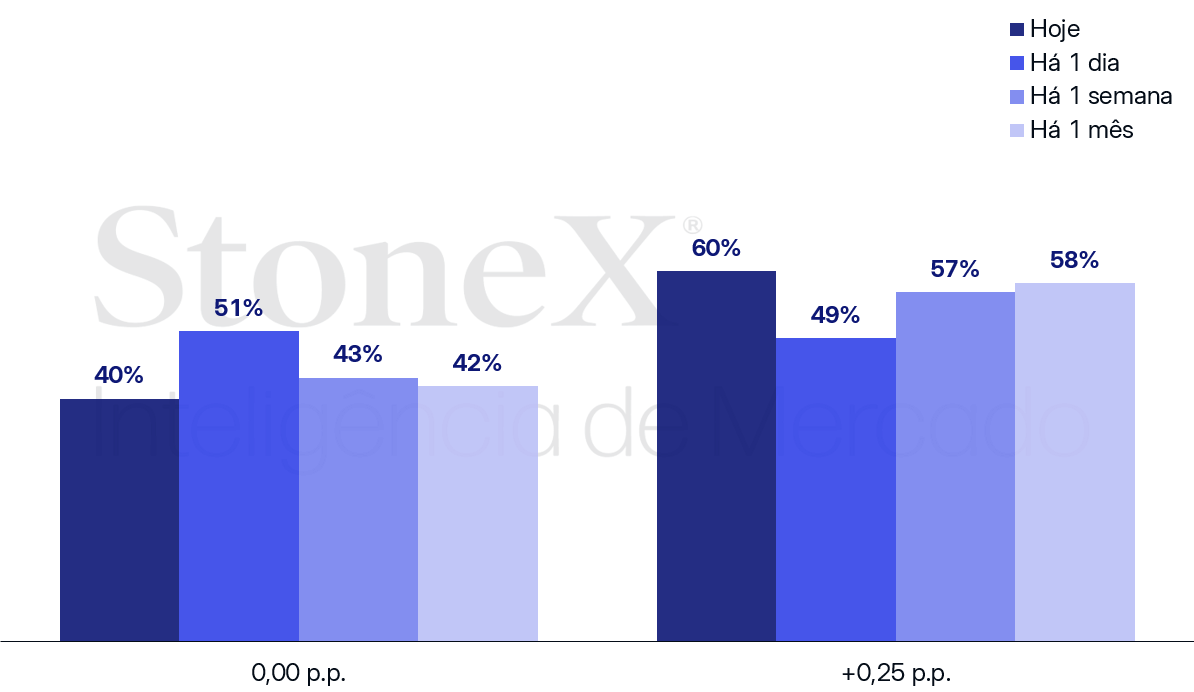
Source: CME FedWatch Tool. Design: StoneX. Market futures interest rate probabilities as of September 4, 2026.
The foreign exchange market is expected to react to the release of the US Consumer Price Index (CPI) and Producer Price Index (PPI) for August, seeking to calibrate expectations for the country's interest rate trajectory.
Why this matters: US inflation is unlikely to clearly signal a stabilization trend, increasing investors' bets on further interest rate hikes by the Federal Reserve, raising US Treasury yields, and attracting foreign capital to the country, strengthening the dollar globally.
Estimates: After two months of moderate US inflation figures, analysts anticipate a slightly warmer reading for August.
- The median projection for the CPI indicates that the monthly variation should increase from 0.1% in July to 0.4% in August, while the core indicator, which excludes the more volatile components of food and energy, should repeat a monthly variation of 0.2%.
- This would bring the core inflation accumulated in 12 months from 2.5% to 2.4%, and reduce the annualized average of the last three months to 1.6%.
- Meanwhile, the median projection for the PPI points to slight acceleration during the period, from 0% to 0.3% for the full index and from 0.2% to 0.3% for its core.
Interest rate hikes in doubt: If the projections are confirmed, the CPI should provide arguments for both sides of the debate. The index's acceleration would hinder a more comfortable signal from the Fed, while the moderation of the core would reduce evidence of a widespread worsening of inflation.
- As such, the reading may not fully meet the requirement of inflation stabilization "clearly and at a sufficient speed," presented by Kevin Warsh in Jackson Hole, but it would not characterize an unequivocal deterioration of underlying pressures either.
- Last week, Fed members, such as the institution's president in New York, John Williams, and Board of Governors member Christopher Waller, indicated that they would need to observe a worsening of inflation trends to advocate for an interest rate hike.
Stronger Payroll in August: Last week, the Employment Situation Report surprised investors by showing much stronger-than-anticipated numbers for the US labor market, softening the reading of weakness caused by the previous two months' reports.
- The United States had a net balance of 162,000 jobs in August, well above the median estimate of 55,000 jobs created.
- Additionally, data for previous months were revised upward, increasing the total originally reported jobs by 55,000.
- Furthermore, the unemployment rate remained at 4.1% despite a recovery in the participation rate from 61.4% to 61.6%.
- This reading points to a healthier and more stable labor market, reinforcing that the balance of risks in the US economy is much more tilted toward inflation than unemployment and increasing the importance of the CPI release for the Fed's September interest rate decision.
Variation in total urban employment (000 of people) and unemployment rate (%) in the United States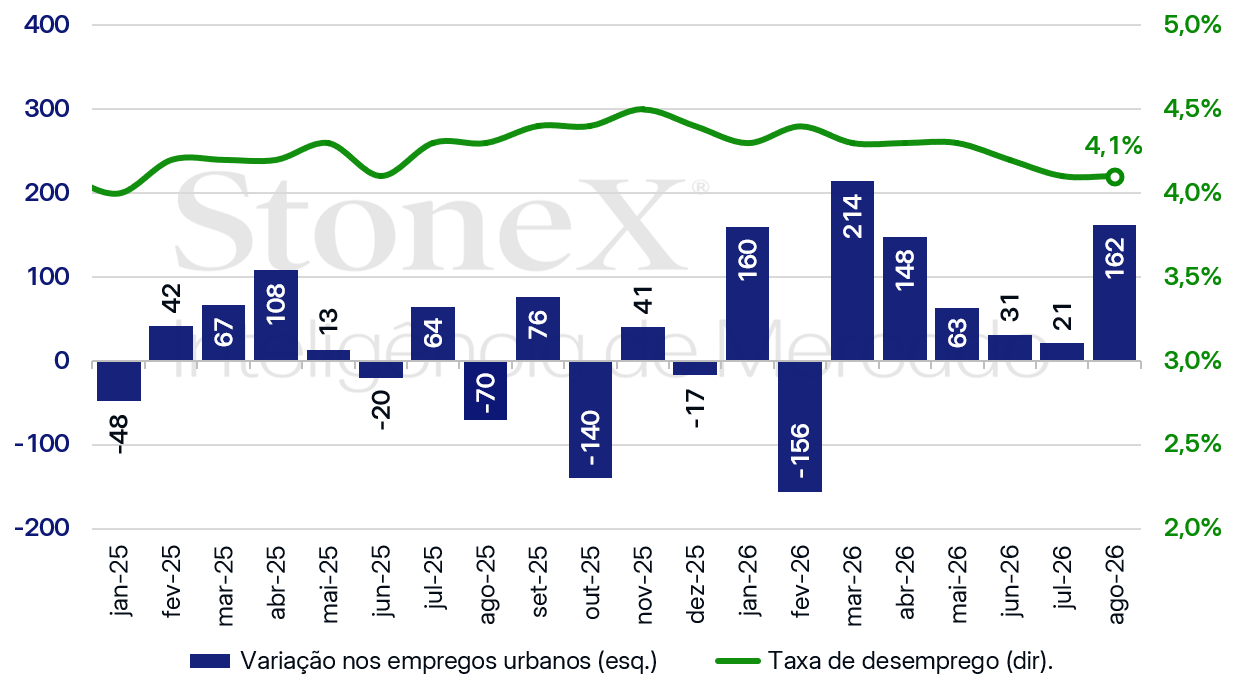
Source: U.S. Bureau of Labor Statistics (BLS), Federal Reserve Bank of St. Louis. Design: StoneX.
Inflation in Brazil
Expected impact on the USDBRL: bullish
Brazil: Historical and expectation for interest rates – Focus bulletin of August 28, 2026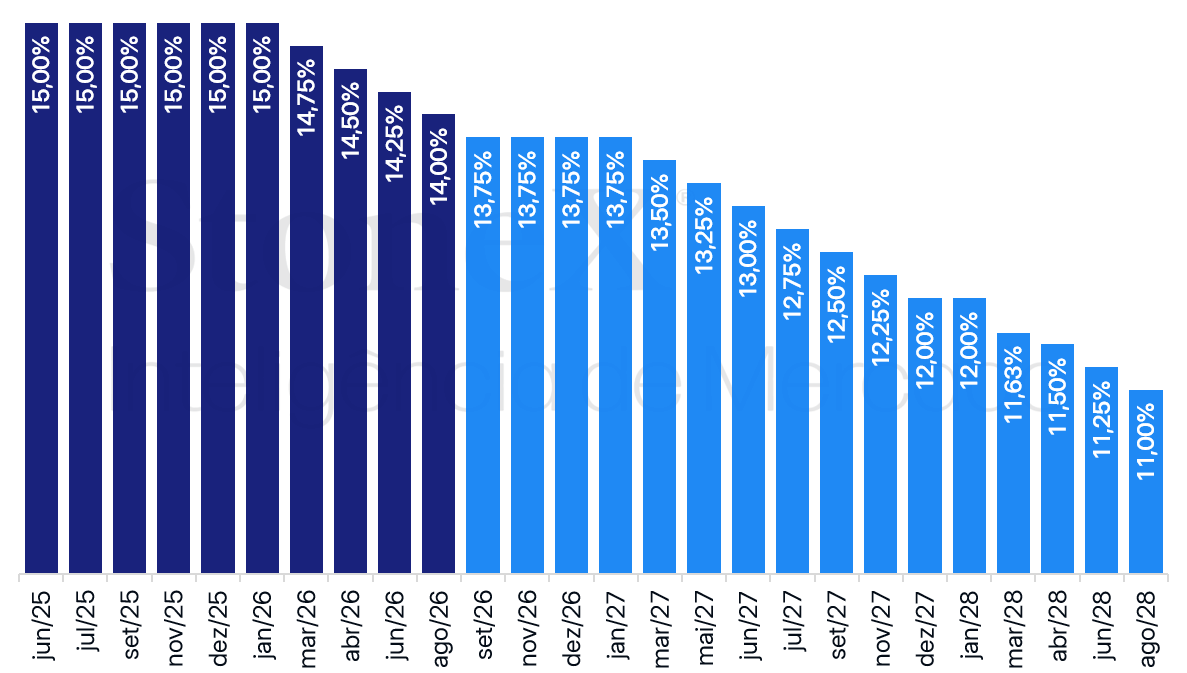
Source: Central Bank of Brazil. Design: StoneX.
In the domestic indicator agenda, investors are expected to react to the August reading of the Broad National Consumer Price Index (IPCA), which should help calibrate expectations for monetary policy management in the country.
- According to the latest Focus Bulletin, the median estimate of financial agents is for deflation of 0.21%, which would slow inflation accumulated over 12 months from 4.44% to 4.34%, keeping the indicator within the target tolerance range.
- The monthly reading should be driven by drops in food, electricity, and transport prices, with emphasis on the temporary effect of the Itaipu bonus on electricity bills.
Why this matters: A benign IPCA reading tends to consolidate expectations for the continuation of the Selic cut cycle, reducing the yields of domestic public bonds and the interest rate differential with the outside world, which could weaken the Brazilian real.
Copom should be more cautious: Since the last Monetary Policy Committee (Copom) meeting, monetary authorities have adopted a more neutral tone, stressing that they will depend on upcoming economic indicators to determine the next steps in monetary policy management.
- In the minutes of the last meeting, Copom indicated an asymmetric upside risk to inflation (i.e., greater risk of faster inflation than slower inflation) and a deviation of investors' inflation expectations from the target for 2027 and 2028, which should increase monetary authorities' caution.
Outlook: The median projection of the Focus Bulletin indicates that a Selic cut is likely at the next meeting, from 14.00% to 13.75% per year, but it may be the last one for the year.
- On one hand, a weaker reading of Gross Domestic Product (GDP) in the second quarter combined with a perspective of slowing inflation in August reinforces bets for further cuts.
- On the other hand, the unemployment rate at 5.3%, near historical lows, favors the reading of a heated labor market and may limit bets for further cuts.

INDICATORS
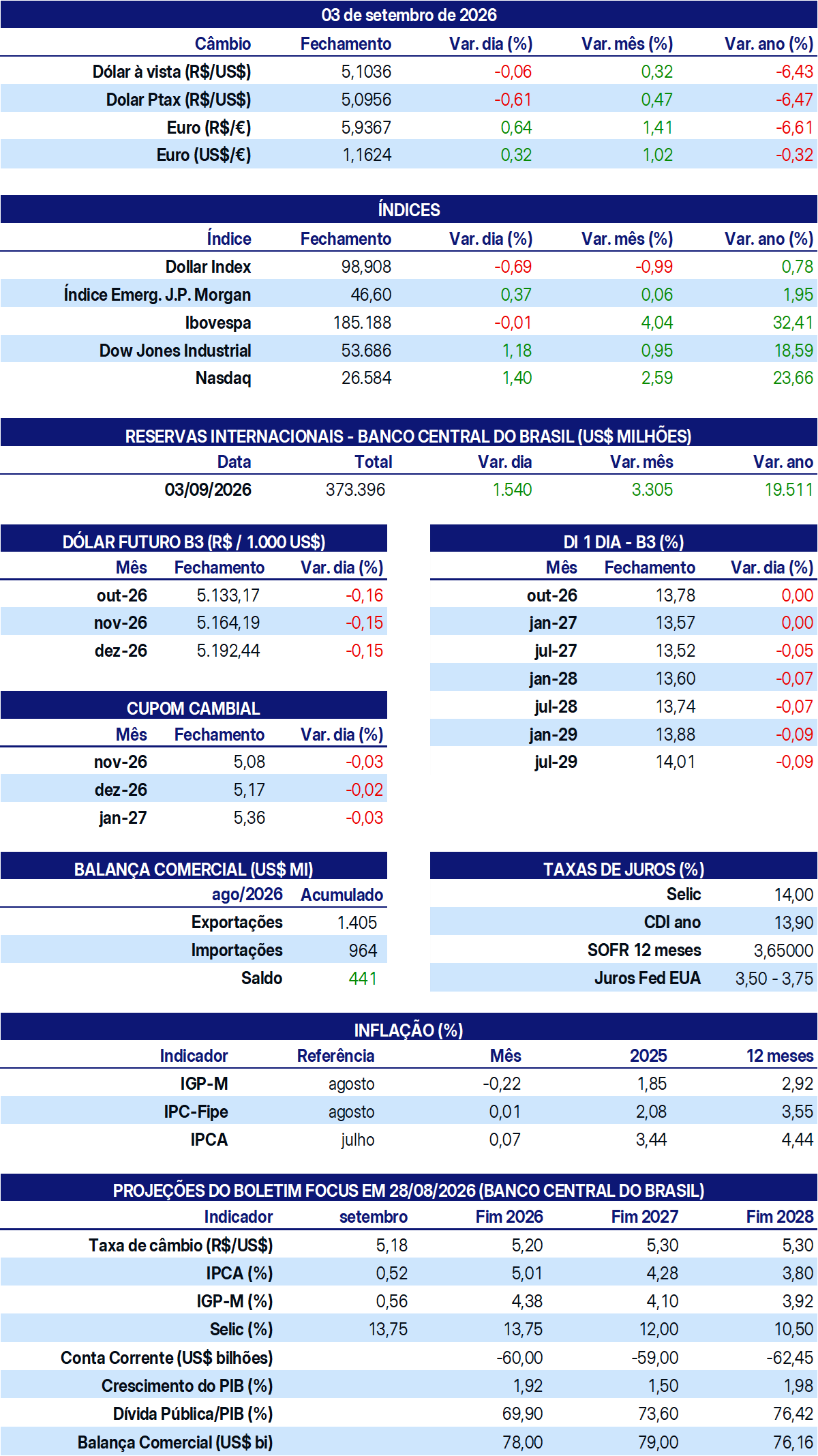
Sources: Central Bank of Brazil; B3; IBGE; Fipe; FGV; MDIC; IPEA; and StoneX cmdtyView.